Is Meta Quest 3 or 3S better? The differences you'll actually notice (and which to buy in 2026)
Same chip, same games, nearly the same weight. What changes is the lenses, the sharpness and, since April, a $250 price gap. Here's which one makes sense in September 2026 and where Valve's new Steam Frame fits.
Is Meta Quest 3 or 3S better? The short answer
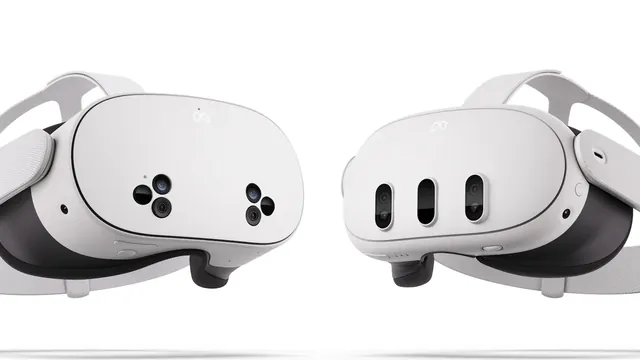
The Meta Quest 3 is the better headset: it has pancake lenses, higher resolution and a wider field of view. But better doesn't always mean better for you. The Quest 3S runs the same chip (Snapdragon XR2 Gen 2), the same 8GB of RAM, the same Touch Plus controllers and the exact same library of games and apps.
Put simply, the 3S plays everything the Quest 3 does, it just looks a bit worse, especially toward the edges of the image. With the Quest 3 you're paying for clarity, visual comfort and a few extras that matter if you play for hours or stream from a PC.
How much do the Quest 3 and Quest 3S cost in 2026?
Meta raised prices on April 19, 2026, pointing to a global spike in component costs, memory chips in particular. On Meta's US store the lineup now looks like this: Quest 3S 128GB at $349.99 (was $299.99), Quest 3S 256GB at $449.99 (was $399.99) and Quest 3 512GB at $599.99 (was $499.99).
The increase also applies to refurbished units, while accessories kept their prices. The Quest 3 only comes in one 512GB version, so the gap between the cheapest 3S and the Quest 3 is $250. Between the 256GB 3S and the Quest 3, it's just $150.
Keep in mind these are US prices before tax. Outside the US, what you actually pay depends on local retailers and import costs, which we cover below.
Pancake vs Fresnel lenses: the difference you'll notice most
This is the biggest change, and you'll see it the moment you put the headset on. The Quest 3 uses pancake lenses, which keep the image sharp from edge to edge and allow a slimmer front. The Quest 3S uses Fresnel lenses, the same type the Quest 2 had: the center looks good, but sharpness drops off toward the sides.
The specs back that up. The Quest 3 has 2064 × 2208 pixels per eye versus 1832 × 1920 on the 3S, roughly 30% more. Its field of view is wider too: 110° horizontal and 96° vertical, compared with 96° and 90° on the 3S. In a fast action game you'll notice it less; with text, menus, virtual movie screens or sims, you'll notice it a lot.
One more detail: the Quest 3 adjusts lens spacing continuously (53 to 75mm), while the 3S only has three positions (58, 63 and 68mm). If your pupil distance falls far from those, the Quest 3 will be more comfortable. Worried about your eyesight? Read whether VR is bad for your eyes.
207Hz, depth sensor and battery: the other differences
With Horizon OS 2.7, which started reaching headsets in late August 2026, the Quest 3 gets Extended Refresh Rates: apps can request up to 207Hz, and developer mode pushes it to 240Hz by turning on display scaling, which lowers the image resolution. It's Quest 3 only. The 3S panel stays capped at 120Hz.
Don't expect an instant upgrade, though. Each app has to support it, and few do today. Virtual Desktop, the app for wirelessly playing PC games on Quest, already offers 144Hz in a beta. It's a real perk if you stream PC VR, but it won't change the games you already own.
The Quest 3 also has a depth sensor the 3S lacks, which helps mixed reality apps understand your room. In exchange, the 3S gets slightly better battery life: Meta quotes about 2.5 hours of average use, versus about 2.2 hours on the Quest 3. Weight is basically a tie (around 515g), and version 2.7 brings Gamepad Mode to both, letting the Touch Plus controllers mimic an Xbox controller in apps like Xbox and Steam Link.
Which should you buy: Quest 3 or 3S?
Get the Quest 3S 128GB if it's your first headset, if it'll be shared around the family, or if you mostly want games, workouts or just to see what VR is about. At $349.99 you get the same library and the same processor as the pricier model.
Get the Quest 3 if you plan long sessions, read a lot of text, work or watch movies in the headset, stream PC games or care about mixed reality. And an honest tip: if you were eyeing the 256GB 3S, add $150 and get the Quest 3 instead. You'll double the storage and get the better optics.
If you can hold off a few days, Meta Connect 2026 runs September 23 and 24, and Meta says it'll cover VR, wearables, the metaverse and AI. No Quest 4 has been confirmed, but it's worth seeing what gets announced before you buy.
Is the Steam Frame better than Quest 3?
Valve launched the Steam Frame on September 14, 2026, at $1,059 (256GB) and $1,299 (1TB), sold through a reservation list that gets randomized. On paper it beats the Quest 3 in several areas: a Snapdragon 8 Gen 3 chip, 16GB of RAM, 2160 × 2160 per-eye displays with pancake lenses, and eye tracking that sends the best image quality exactly where you're looking when streaming from a PC. It works standalone on SteamOS and as a PC VR headset.
But it's in a different price bracket: about $460 more than a Quest 3, and Valve's power supply is sold separately ($29), though any USB-C charger rated 45W or more works. It makes sense if you already own a big Steam library and a gaming PC. If you want a standalone headset with a deep library at a reasonable price, the Quest 3 is still the logical pick. We break down the total in how much the Steam Frame costs and go deeper in Steam Frame vs Quest 3 vs Quest 4.
FAQ
How much is the Quest 3S?
On Meta's US store, the Quest 3S costs $349.99 with 128GB and $449.99 with 256GB, after a $50 increase that took effect April 19, 2026. Prices in other countries depend on local retailers and import costs.
How much does the Meta Quest 3 cost?
$599.99 on Meta's US store for its only version, with 512GB of storage. The price went up $100 on April 19, 2026, due to rising memory chip costs.
Is the Steam Frame better than Quest 3?
On paper, yes in several ways: 16GB of RAM, a Snapdragon 8 Gen 3 chip, 2160 × 2160 per-eye displays and eye tracking. But it starts at $1,059, about $460 more than a Quest 3, and makes the most sense if you already play PC VR on Steam.
Does Quest 3S play the same games as Quest 3?
Yes. Both use the Snapdragon XR2 Gen 2 with 8GB of RAM and access the same store library. The difference is image quality, not which games you can run.